The $1.29B IBIT Dark Pool Trade: Follow the Rotation Into Perps
By CMM Team - 27-May-2026
The $1.29B IBIT Dark Pool Trade: Follow the Rotation Into Perps
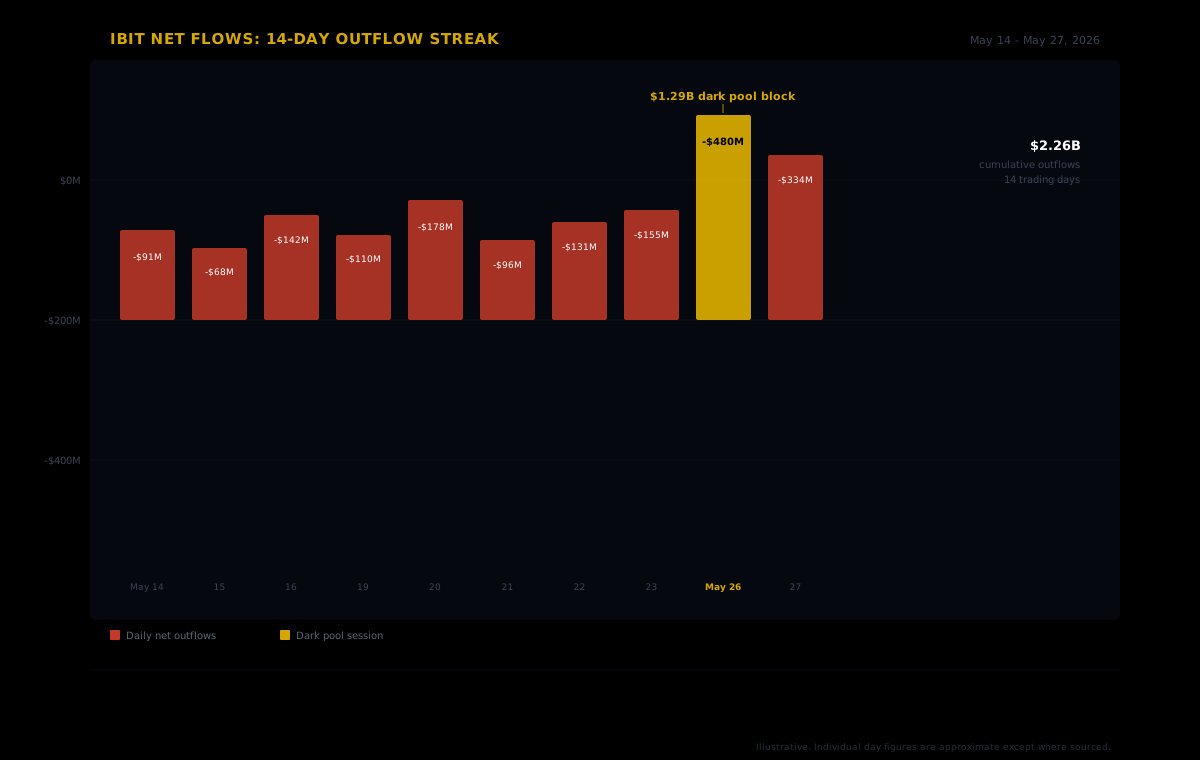
Someone unloaded $1.29 billion worth of BlackRock's IBIT in a single dark pool transaction yesterday morning, and Bitcoin barely moved. The block crossed at 10:30 a.m. ET, 29 million shares at roughly $43 apiece. Galaxy Research's Alex Thorn called it the biggest dark pool trade he had ever seen. Bloomberg's Eric Balchunas confirmed the print was more than 22 times the size of the second-largest IBIT sell order that day.
Headlines panicked. Bitcoin slid from roughly $78,000 to $75,677 over the next 12 hours. IBIT itself? Closed slightly higher at $42.99. The trade was absorbed. And that mismatch between the headline fear and the actual market response is where the interesting story starts for perp traders.
This is not a collapse narrative. It is a rotation narrative, and our data on Hyperliquid's perp markets reveals exactly who is on each side of it.
Inside the Block: What a Dark Pool Trade Actually Is
Dark pools are private trading venues where institutional investors execute large orders without exposing them to the public order book. The logic is simple: if you want to sell $1.29 billion of anything and you place it on a lit exchange, the price craters before you finish filling. A dark pool matches buyer and seller privately, so the size of the order does not move the market until after it prints.
This particular block, roughly equivalent to 16,400 BTC, crossed as what Bloomberg's analysts classified as an intermarket sweep order. That matters because sweep orders are designed for speed. Whoever sold wanted out fast, not at the best possible price. Speed of exit over price optimization is a tell: it suggests portfolio rebalancing or a structured product adjustment, where timing matters more than ticking off every last basis point.
The Bigger Picture: Eight Straight Days of Outflows
The dark pool block did not happen in isolation. It landed during an eight-session streak of net outflows from U.S. spot Bitcoin ETFs. On May 27 alone, the complex saw $333.6 million in net redemptions. IBIT absorbed $192.44 million of that. Over the two weeks leading up to the block trade, cumulative outflows reached $2.26 billion.
Total AUM across the spot BTC ETF complex dropped from just above $102 billion to under $100 billion. The selling has been broad-based, but mid-tier issuers like ARKB and BITB saw proportionally heavier outflows, which suggests the redemptions are weighted toward newer institutional positions rather than the core long-term holders.
Where the Capital Actually Went (Hint: It Stayed in Crypto)
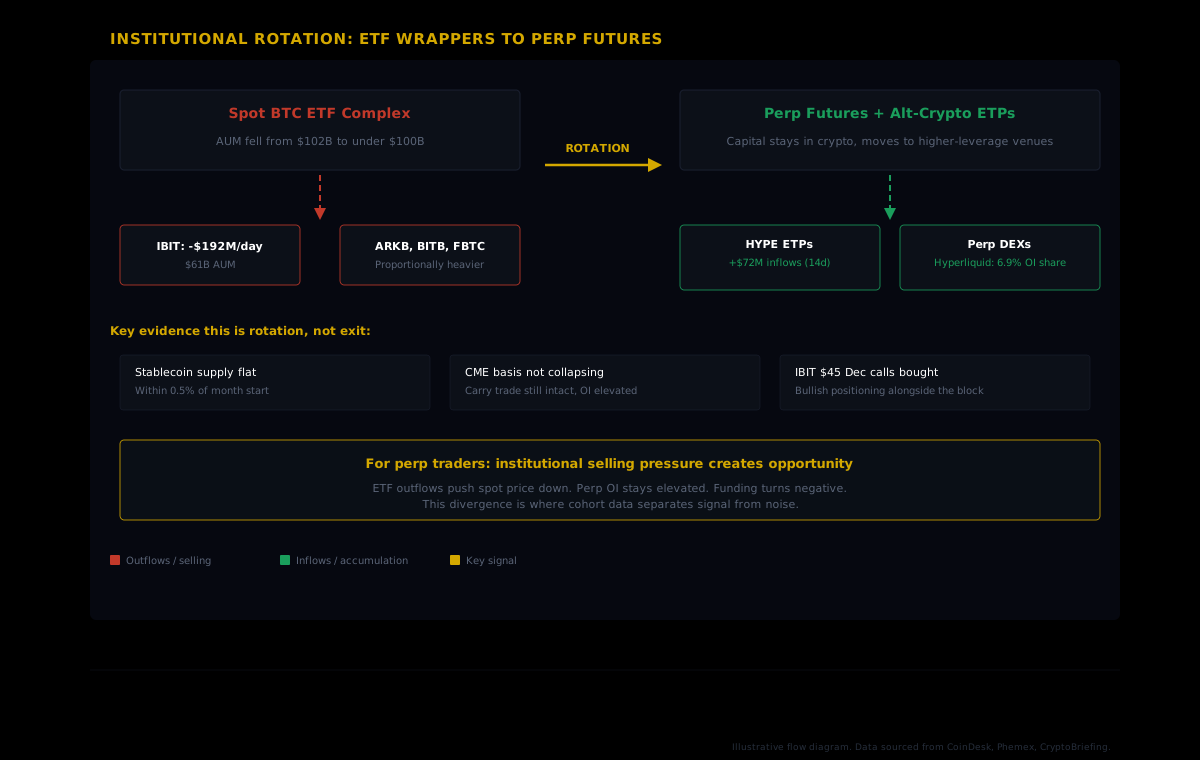
Here is the part the headline writers missed. While spot BTC ETFs bled $2.26 billion over 14 days, HYPE exchange-traded products pulled in $72.38 million in net inflows over the same period. XRP funds added approximately $22 million. Solana ETFs attracted $15.6 million. Ethereum funds were roughly flat.
Stablecoin supply stayed within 0.5% of where it sat at the start of the month. That is the single most important data point in the rotation thesis. If institutions were truly exiting crypto, stablecoins would be getting redeemed. They are not. The capital is moving within the asset class: from the largest, most liquid Bitcoin wrapper into higher-beta plays and, critically, into derivative instruments.
Meanwhile, the CME Bitcoin futures basis has not collapsed. CME open interest remains elevated, which means the institutional carry trade (long ETF, short futures) is still being maintained even as some ETF holders exit. The implication: what is leaving IBIT is not the basis-trade book. It is directional holders who are rotating into other venues and assets.
The Bullish Undercurrent: Options Flow Says More Than the Block
At almost the same time the $1.29 billion block crossed, nearly $1 million flowed into December 2026 IBIT call options at the $45 strike. With IBIT closing at $42.99 that day, these are out-of-the-money bets that Bitcoin will be higher by year-end. Someone was betting against the panic narrative in real time.
This is a pattern worth internalizing. Institutional-scale selling in ETF wrappers does not always mean bearish conviction. Rebalancing, tax harvesting, structured product expirations, and portfolio mandate shifts all produce selling flow that looks scary on a chart but carries zero directional signal. The options market often tells you what the same institutions are actually thinking about the next six months.
Why Perp Traders Should Care About ETF Outflows
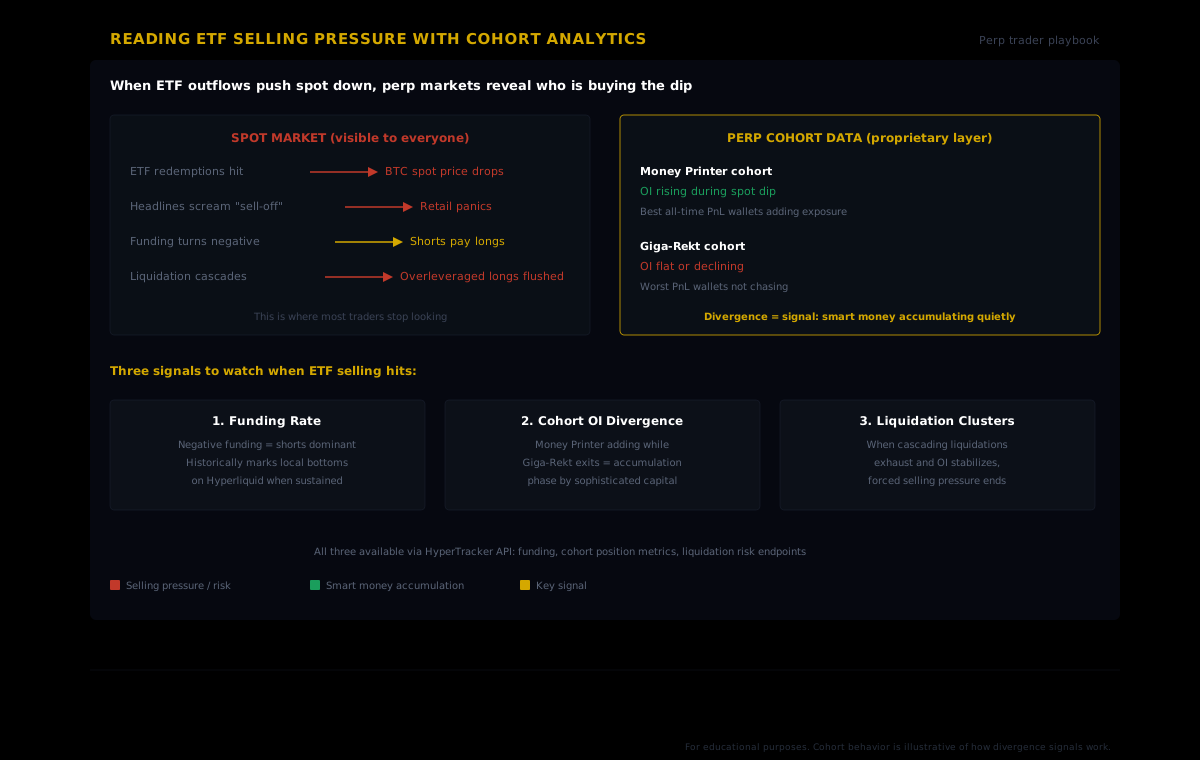
ETF redemptions exert real selling pressure on Bitcoin's spot price because authorized participants arbitrage the NAV gap by selling actual Bitcoin. When $333.6 million leaves the ETF complex in a day, that is not abstract. Market makers sell BTC on spot venues to balance the books. Price drops. Perp funding adjusts. Liquidation levels get tested.
But here is where it gets useful. ETF outflow-driven selling creates a specific pattern on Hyperliquid's perp markets:
- Spot price drops as ETF redemptions settle. This is mechanical, not sentiment-driven. The selling stops when the redemption window closes.
- Perp funding turns negative. As spot falls, perp prices sometimes lag below spot, and shorts start paying longs. Negative funding on Hyperliquid is an hourly cost (Hyperliquid settles funding every hour, compared to the typical eight-hour cycle on centralized exchanges). Sustained negative funding during ETF-driven dips has historically marked local bottoms.
- Liquidation cascades flush overleveraged longs. The mechanical selling pressure from ETF redemptions can trigger cascading liquidations in perp markets, especially on low-timeframe positions. Once the most vulnerable positions are flushed, forced selling pressure exhausts.
- Smart money accumulates during the dip. This is where cohort analytics become the edge. Our data classifies every wallet on Hyperliquid into 16 behavioral cohorts by perp equity size and all-time PnL. During ETF-driven sell-offs, the divergence between cohorts reveals whether the dip is being bought by historically profitable wallets or abandoned by everyone.
Reading the Dip with Cohort Data
Consider two of HyperTracker's PnL-based cohorts. The Money Printer cohort (segment ID 8) contains wallets with over $1 million in cumulative perp PnL. These are the best-performing traders on the exchange, and their aggregate positioning is available through a single API call. At the other end, the Giga-Rekt cohort (segment ID 15) contains wallets with the worst all-time PnL, below negative $1 million.
When ETF selling pressure pushes BTC spot down and perp prices follow, two things can happen in the cohort data:
| Scenario | Money Printer OI | Giga-Rekt OI | Read | | --- | --- | --- | --- | | Accumulation dip | Rising | Flat or declining | Best PnL wallets are adding exposure while worst PnL wallets step aside. The dip is being absorbed by sophisticated capital. | | Genuine sell-off | Flat or declining | Rising | Smart money is not stepping in. Giga-Rekt wallets are trying to catch the knife. Historically resolves against them. | | Full capitulation | Declining | Declining | Everyone is exiting. Wait for OI to stabilize before re-entering. |
The divergence between these two cohorts during ETF outflow events is one of the cleanest signals available on Hyperliquid. You cannot get it from price charts alone, because price tells you what happened. Cohort OI tells you who did it.
Hyperliquid's Growing Share of the Derivatives Pie
This rotation matters more for Hyperliquid traders than it would have even six months ago. The platform now commands a record 6.9% of aggregate perpetual futures open interest when measured against centralized exchanges. Among decentralized perp exchanges, Hyperliquid commands the dominant share of open interest, far ahead of any competitor.
HIP-3 markets, which allow permissionless perp trading on real-world assets like gold, oil, and equity indices, have added another layer of institutional relevance. When ETF outflows create macro selling pressure, HIP-3 assets like S&P 500 perps and commodity futures on Hyperliquid offer hedging venues that did not exist a year ago.
The growth trajectory is clear: more institutional capital touching Hyperliquid means ETF-level events like the IBIT dark pool trade will have increasingly measurable effects on Hyperliquid's order flow. That is a feature if you have the analytics to read it.
Track Institutional Rotation in Real Time
HyperTracker's API gives you per-cohort position metrics, funding rates, and liquidation risk scoring across every asset on Hyperliquid. When ETF outflows create selling pressure, our data shows you which cohorts are buying and which are running. 16 behavioral cohorts. One API call. Starting at $179/mo.
What to Watch This Week
The dark pool trade happened on May 26. Wednesday's flow data will confirm whether it triggers a record single-day IBIT outflow or gets absorbed by new buyers stepping in. Three things to monitor:
- Wednesday ETF flow data: If IBIT posts another large redemption, the selling pressure extends. If flows stabilize or reverse, the block was a one-off rebalancing event.
- Hyperliquid BTC perp funding: Sustained negative funding during the dip would signal that shorts are crowded and a squeeze is building. HyperTracker surfaces funding rates per asset with our rolling 5-minute snapshots.
- Money Printer vs. Giga-Rekt divergence on BTC: If historically profitable wallets are adding BTC perp exposure while the dip continues, the accumulation thesis holds. If both cohorts are flat, patience.
The $1.29 billion block was the largest dark pool ETF trade on record, and Bitcoin absorbed it with a 3% drawdown that partially recovered within hours. That resilience, combined with bullish options positioning and stable stablecoin supply, points to rotation rather than retreat. For perp traders on Hyperliquid, the question is not whether this sell-off matters. The question is which cohort is on your side of the trade.