
Two Engineers, 21 Perp Trades, and the DOJ's New Front-Running Playbook
By CMM Team - 16-Sep-2026
Two Engineers, 21 Perp Trades, and the DOJ's New Front-Running Playbook
The Department of Justice just made one thing very clear: trading perpetual futures on a decentralized exchange does not put you beyond the reach of U.S. commodities law. On September 15, 2026, federal prosecutors in the Southern District of New York unsealed complaints charging two former Robinhood engineers with commodities fraud and wire fraud for allegedly front-running crypto listing announcements through perpetual futures on Hyperliquid.
The case is a first. Previous crypto insider-trading prosecutions targeted people who bought the actual tokens before a listing. This time, the defendants allegedly expressed their bets through leveraged perpetual contracts on an on-chain DEX, apparently believing that pseudonymity and derivatives would provide cover. It didn't.
For anyone building or trading on Hyperliquid, this case reshapes the risk landscape. Here's what happened, why it matters, and what on-chain transparency means for the future of enforcement.
The Charges: What the DOJ Alleges
The complaints name Hefu Chai, 36, of Menlo Park, California, and Huaisong Xiang (also known as Jerry Xiang), 30, of Jersey City, New Jersey. Both worked as engineers at Robinhood, where their roles gave them access to nonpublic information about which crypto assets Robinhood Crypto planned to list and when those listings would be announced.
Between 2025 and 2026, prosecutors allege the pair repeatedly opened perpetual futures positions on Hyperliquid tied to tokens that Robinhood was about to list. Chai allegedly traded ahead of at least 10 listing announcements. Xiang allegedly did so on at least 11 occasions. Each defendant allegedly profited more than $50,000.
Each defendant faces one count under the Commodity Exchange Act (maximum 10-year sentence) and one count of wire fraud (maximum 20-year sentence). Chai is scheduled to appear in the Northern District of California, while Xiang will appear in Manhattan before U.S. Magistrate Judge Ona T. Wang. The case is being handled by the SDNY's Securities and Commodities Fraud Task Force.
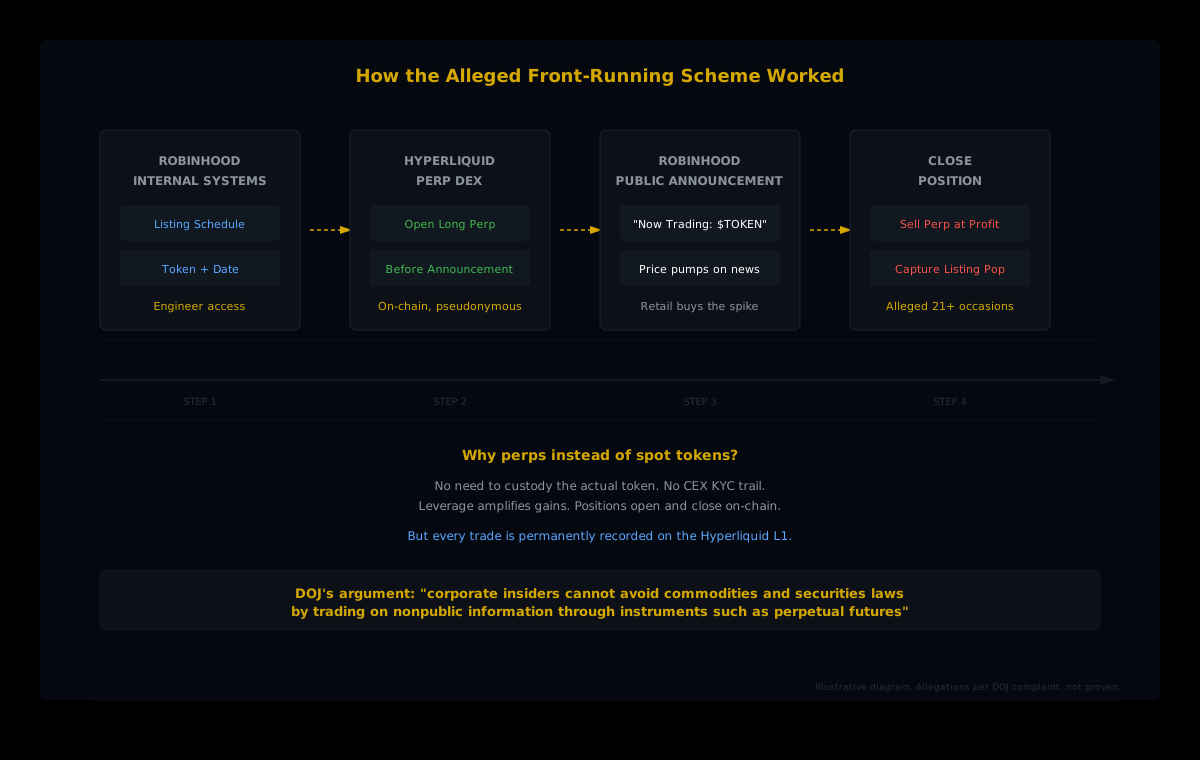
Why Perps Instead of Spot Tokens?
In the 2022 Coinbase insider-trading case, which the DOJ called the "first-ever cryptocurrency insider trading" prosecution, former Coinbase product manager Ishan Wahi tipped his brother and a friend, who then bought spot tokens through Ethereum wallets before listing announcements. The scheme was relatively straightforward: buy token, wait for listing pump, sell token.
The Robinhood case is structurally different. Instead of buying the underlying tokens, Chai and Xiang allegedly used perpetual futures on Hyperliquid. This approach carries several tactical advantages for someone trying to trade on inside information:
- No need to custody the token. Perps track the price of an asset without requiring ownership. The trader only posts margin in USDC.
- Leverage amplifies gains. A modest deposit can control a much larger notional position, so even a small listing pop generates outsized returns.
- No CEX KYC trail. Hyperliquid is a decentralized L1. Users connect a wallet and trade. There's no identity verification at the protocol level.
- Positions open and close quickly. Perpetuals have no expiry date. A trader can enter before the announcement and exit minutes after, leaving a minimal footprint.
At least, that's the theory. The DOJ's complaint suggests the pseudonymity wasn't as protective as the defendants may have believed.
The On-Chain Transparency Paradox
Here's where the case gets interesting for the broader DeFi ecosystem. The very feature that makes perp DEXes attractive to insiders, pseudonymous access, coexists with a feature that makes enforcement easier: radical transparency.
Every perpetual futures trade on Hyperliquid is an L1 transaction. Position opens, position closes, funding payments, liquidations: all of it is permanently recorded on-chain and queryable by anyone. Independent researchers flagged suspicious wallet activity months before charges were filed.
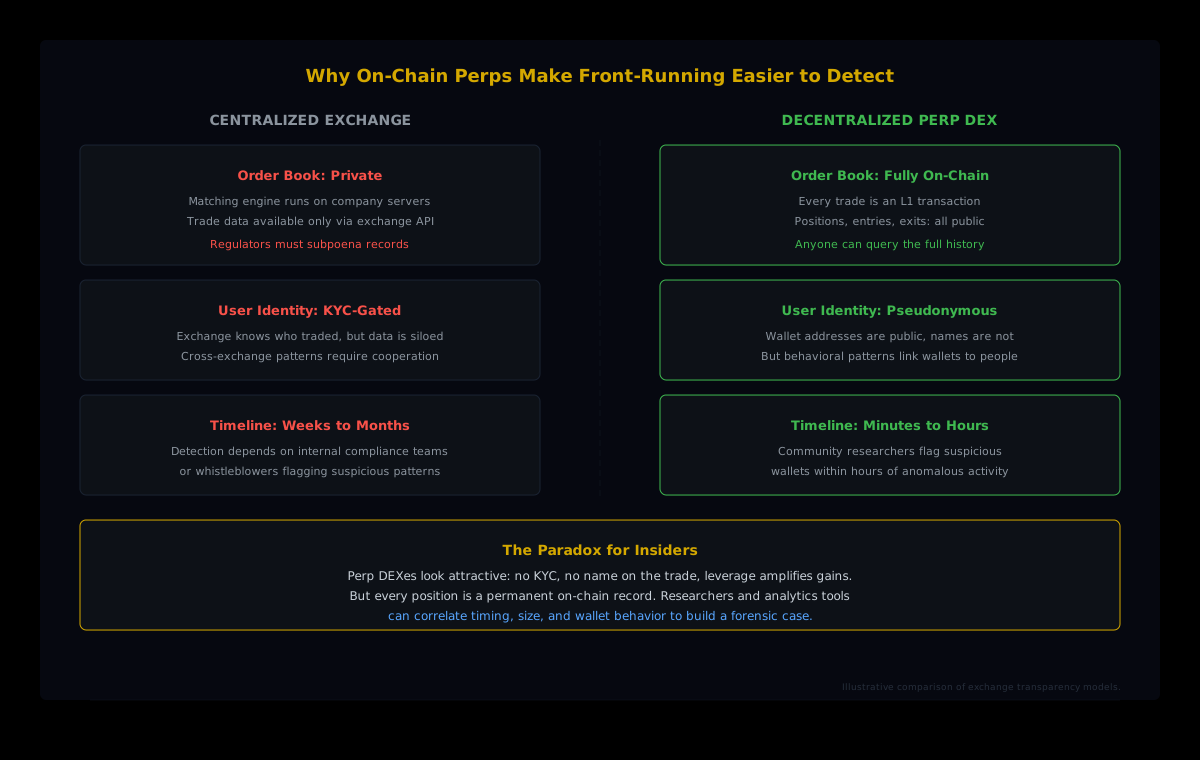
Compare this to insider trading on a centralized exchange, where the order book is private, matching happens on company servers, and regulators have to subpoena records from the exchange itself. On a CEX, detection depends on internal compliance teams or whistleblowers. On a perp DEX, anyone with a block explorer or analytics tool can spot a wallet that consistently opens positions in tokens right before major announcements.
The pattern is unmistakable when you know what to look for. A wallet opens long perps on token X. Three days later, Robinhood announces spot trading support for token X. The price spikes. The wallet closes the position at a profit. Repeat 10 or 11 times, and the statistical improbability becomes a federal complaint.
Key legal theory: Prosecutors argued that confidential listing information retains its legal protections "because a trader routes the order through an on-chain venue rather than a regulated exchange." Using a DEX doesn't erase the fraud.
From Coinbase to Robinhood: How Crypto Insider Trading Cases Evolved
The 2022 Coinbase case set the template. Ishan Wahi, a product manager who knew which tokens were about to be listed, tipped his brother Nikhil Wahi and friend Sameer Ramani. They bought tokens ahead of at least 14 listing announcements between June 2021 and April 2022 and generated at least $1.5 million in gains. Ishan eventually pled guilty to two counts of conspiracy to commit wire fraud, becoming the first person convicted of cryptocurrency insider trading.
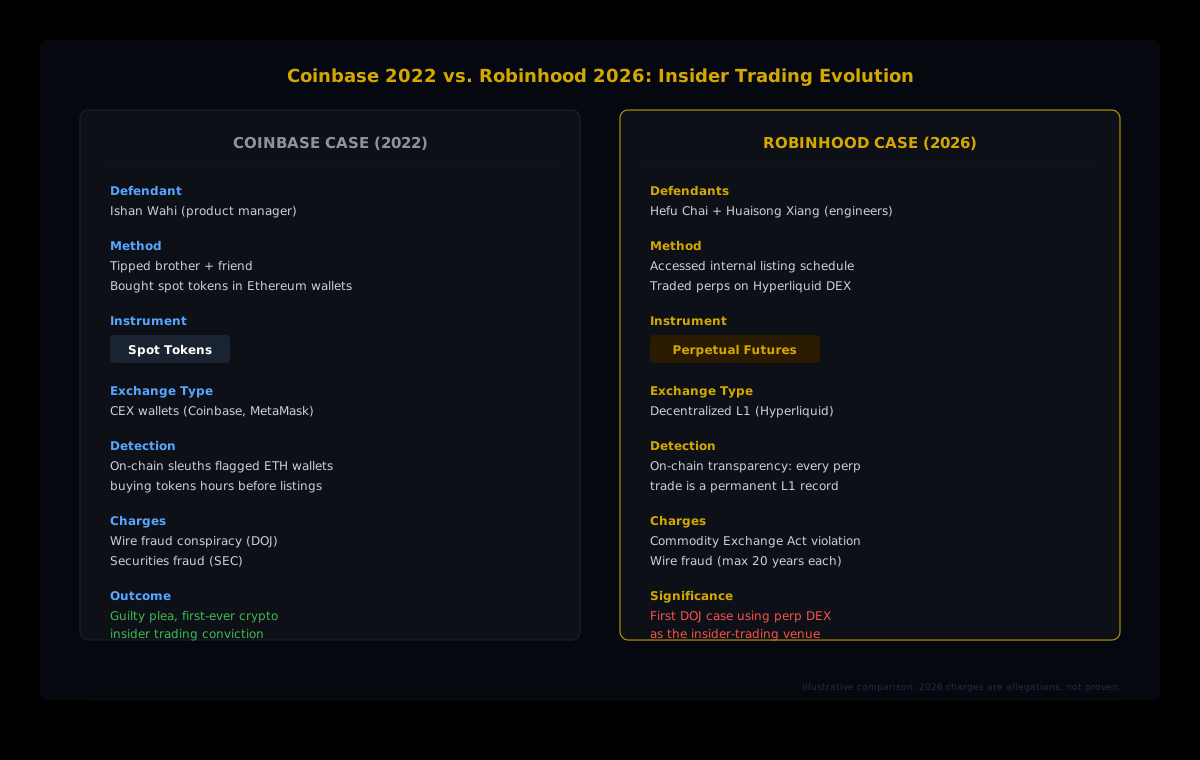
The Robinhood case advances the enforcement frontier in two ways. First, the instrument: perpetual futures contracts on a decentralized exchange, which carry different regulatory classification than spot tokens. Second, the venue: an on-chain DEX operating without centralized custody or KYC. If the DOJ secures convictions here, the precedent applies to every perp DEX, because the legal argument is about the information being misused, not the platform on which the trade happens.
As U.S. Attorney Jamie McDonald stated: "Misappropriating confidential information to trade in the derivatives markets for personal benefit is illegal."
Robinhood cooperated with the investigation, reported the matter to law enforcement and regulators, and stressed a zero-tolerance policy on insider trading.
What This Means for Perp DEX Traders
If you trade perpetual futures on Hyperliquid or any other decentralized derivatives platform, the Robinhood case crystallizes a few realities:
- Pseudonymity is not anonymity. Wallets are public addresses, and behavioral patterns (timing, size, asset selection) create a fingerprint that can be correlated with off-chain identities. The FBI and SDNY have demonstrated the ability to make these connections.
- Commodity Exchange Act applies to perps. The DOJ charged under the Commodity Exchange Act, which means perpetual futures are being treated as commodity derivatives subject to U.S. law. The distinction between "decentralized" and "regulated" doesn't matter to federal prosecutors.
- On-chain data is the prosecution's friend. Every position you open, every entry price, every close, every funding payment: it's all permanently and publicly recorded. An analytics tool that tracks cohort-level positioning can surface anomalous behavior well before a subpoena is filed.
- Listing-announcement alpha is a liability. If you work at a company that lists tokens and you trade on that information through any channel, including a pseudonymous wallet on a DEX, the legal exposure is real and carries up to 30 years in combined maximum sentencing.
For Builders: On-Chain Transparency as a Feature
This case actually strengthens the case for building on transparent perp DEXes. The DOJ's ability to bring charges hinged on the fact that Hyperliquid's on-chain data made suspicious patterns visible. This is a feature, not a bug. Protocols that offer verifiable, transparent trading data position themselves as partners in market integrity, which matters increasingly as institutional capital flows into DeFi derivatives.
For developers building analytics layers on top of Hyperliquid, the enforcement trend creates demand for tools that can:
- Flag anomalous pre-announcement positioning. If a wallet consistently takes positions in tokens that get listed on major platforms days later, that pattern is detectable through cohort-level analytics.
- Track wallet behavior across multiple tokens. One lucky trade is noise. A pattern across 10 or 11 listings is signal. Time-series analysis of wallet-level positioning data separates the two.
- Correlate on-chain activity with off-chain events. Mapping position opens against a calendar of exchange listing announcements, regulatory decisions, or corporate events creates an evidence trail that compliance teams and researchers can act on.
Our data classifies every wallet on Hyperliquid into 16 behavioral cohorts: 8 by size (from Shrimp to Leviathan) and 8 by all-time PnL (from Money Printer to Giga-Rekt). When a small wallet suddenly starts taking outsized, perfectly timed positions in obscure tokens days before listing announcements, that behavioral shift shows up clearly in cohort-level analysis.
Track Wallet Behavior Across Hyperliquid
HyperTracker's API classifies every wallet into 16 behavioral cohorts. Spot anomalous positioning before the chart moves.
The Bigger Picture: Enforcement Follows the Volume
Perp DEX volume has grown significantly throughout 2026, with Hyperliquid emerging as the category leader. As volume grows, so does regulatory attention. The Robinhood case signals that the DOJ treats on-chain derivatives markets with the same seriousness as traditional futures markets.
This isn't the first time Hyperliquid's on-chain transparency has intersected with high-profile trading activity. On-chain researchers have flagged large, precisely timed positions on multiple occasions. The difference now is that federal prosecutors are using the same transparent data to build criminal cases.
For the ecosystem, this is a maturation signal. Markets that can be policed attract institutional capital. On-chain transparency, combined with analytics tools that surface behavioral patterns at the cohort level, creates a self-regulating feedback loop: bad actors leave traces that community researchers and compliance tools can detect, which then provides evidence for enforcement actions, which deters the next round of bad actors.
The two former Robinhood engineers face their court dates. The allegations remain unproven until trial. But the legal theory, that commodities law reaches through any instrument and any venue to the person misusing confidential information, is now on the record. For perp DEX traders, the lesson is practical: every position you take on-chain is a public record, timestamped and permanent. Build and trade accordingly.